

Telstar: narrowing transatlantic divide to size of TV screen
A look at the day in 1962 when the world witnessed a huge advancement for international communications via satellite

As Paul Stevens, editor of the Connecting newsletter for Associated Press alumni, noted in Thursday’s edition our colleague Mark Mittelstadt, at the age of 8, in the year 1962, was not able to comprehend the full significance of what we saw or realize what the advancements in international communications would mean to what would become his employer – The AP - two decades later. He recalls the event from 64 years ago when a large antenna in Andover, Maine, relayed an electronic signal to a 171-pound satellite to begin a live television broadcast from the United States to Europe.
With his own research and that of Sarit Hand of AP Corporate Archives, he writes about Telstar. Mark has kindly given permission for us to post his compelling article here today.
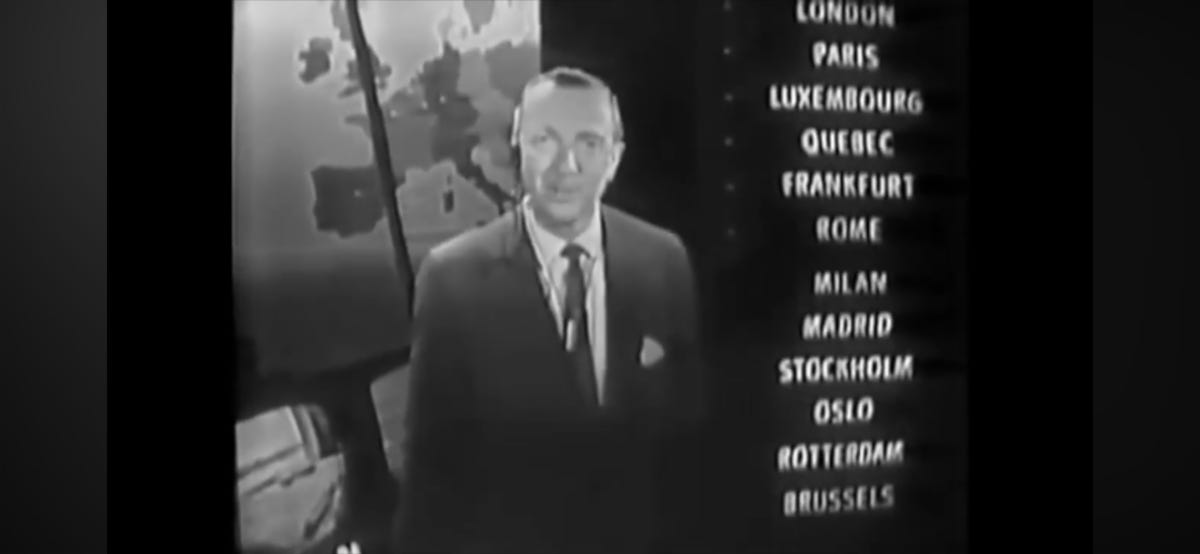
Mark Mittelstadt - At 3 p.m. Eastern 64 years ago today (July 23), a large antenna in Andover, Maine, relayed an electronic signal to a 171-pound satellite to begin a live television broadcast from the United States to Europe.
Telstar 1, launched from Cape Canaveral 13 days earlier, was the first telecommunications satellite and achieved live international transmission of television images.
“Americans got a look at Europe, and Europeans got a look at the United States Monday in the first exchange of live television programs,” a New York-datelined story from The Associated Press said. “Pleasantries were expressed on both sides of the Atlantic, as the once-formidable distance between the two continents shrank to the size of a home television screen.”
The 20-minute American broadcast, and a subsequent European feed hours later, marked a huge advancement for international communications via satellite. It supported much of what AP and other companies would later achieve. It also was a Cold War thumb in the eye to the Soviet Union, whose launch of its Sputnik 1 satellite in 1957 caught American officials off-guard and is viewed by many as the start of the global space race.
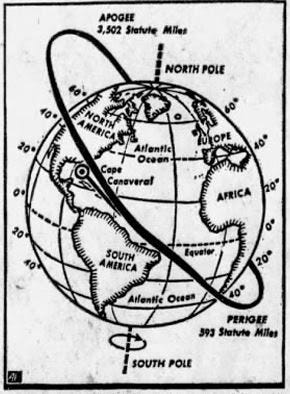
The Telstar satellite circled the globe about every 157.8 minutes, with a perigee of 503 miles and an apogee of 3,502 miles. (AP Wirephoto Map)
The American part of the broadcast was hosted by CBS anchor Walter Cronkite and NBC co-anchor Chet Huntley. Europe received panoramic glimpses of American life including the Statue of Liberty, a presidential news conference, a busy Detroit expressway, a summer theater, hula dancers, astronauts, the United Nations, a fairground and the chiseled faces on Mount Rushmore.
In an apparently unscripted moment, Huntley announced the Maine center had linked with the satellite early so to fill time before President John Kennedy’s news conference producers cut to a broadcast of a Chicago Cubs - Philadelphia Phillies baseball game. During the minute and a half feed, it was announced to the Wrigley Field crowd that the game was appearing on Telstar and they were encouraged to stand and cheer. Which they did.
Europe followed approximately three hours later with pictures of Big Ben in London, a Paris street scene, a Swedish maid, Sicilian boats and fisherman, a Vienna riding school, the Square of the Republic in Belgrade, a Rome opera, a scientific center in Geneva and the heart of industrial Germany.
The short Mount Rushmore segment provided the memory of a lifetime for our family. Tent camping in the Black Hills, our parents drove us to the national monument. As we became aware much later of the significance of July 23, 1962, my sister and I don’t know whether our folks knew they were taking us to an historic event that included a short performance of the Mormon Tabernacle Choir, or just to see the iconic 60-foot faces of George Washington, Thomas Jefferson, Theodore Roosevelt and Abraham Lincoln.
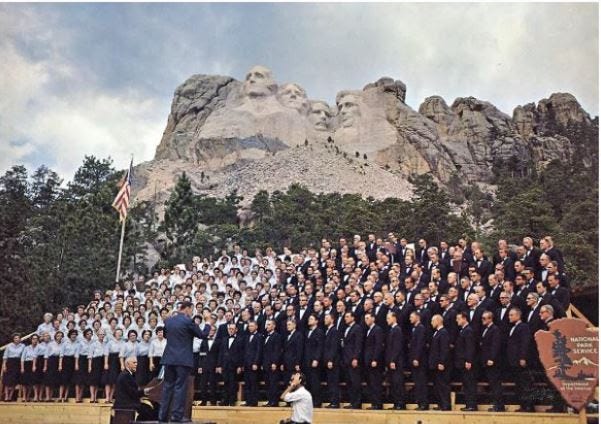
The Mormon Tabernacle Choir performed at the foot of Mount Rushmore on July 23, 1962, part of the first live international satellite broadcast called Operation Telstar. (LDS Church Archives)
In a scrapbook entry, our mother wrote that “the line of cars moved slowly and some stalled along the way... Cars were turned away because of performance of Mormon Tabernacle Choir on Telstar. As we approached the entrance, we were flagged into (the) parking lot. Crammed down peanut butter sandwiches and ran to the amphitheater. Saw the cameras taking pictures. Heard the beautiful music. Hawk circled overhead.” Dad used his Brownie 8mm camera to film a 30-second now grainy sweep of the choir and the hundreds of people filling the amphitheater seats.
On cue to catch their split in the broadcast, the choir opened with a song meant to appeal to the sensibilities of Europe, “A Mighty Fortress Is Our God,” composed in the 1520s by Martin Luther. It was followed approximately five minutes later by the American anthem “Battle Hymn of the Republic,” which served as the musical bed for closing scenes of the American broadcast.
Before the choir’s performance the broadcast showed a Dakotas buffalo herd stampede, live and on cue, prompted by dynamite and shotguns.
The choir’s appearance at Mount Rushmore was a last-minute addition arranged by William F. Turner, described years later by the New York Times as a “fast-talking 33-year-old television executive” in Rapid City, S.D. Turner was not Mormon but knew President John F. Kennedy through connections made while working in New England. He said he used that leverage to get a spot on the Telstar ticket.
Informed of being part of the satellite broadcast only two weeks before, 310 choir members gathered at a Salt Lake City airport at 3:30 a.m. July 23 for a flight to a South Dakota military base. A two-hour bus ride to the national monument was made under what the Times called “a dark and threatening sky.” As the singers waited on the platform in white blouses and dark suits, torrential rain fell, drenching them and their sheet music.
“Choir finished and it poured down rain,” our mother wrote. “Ran through it to car... The choir was the highlight of the entire trip.”
At age 8 I could not comprehend in 1962 the full significance of what we saw or realize what the advancements in international communications would mean to what would become my employer two decades later. From the company’s archives, AP played a major role testing distribution of content over transatlantic satellite.
Immediately after the July 10 Telstar launch, television pictures were being relayed into the homes of Americans with images also being picked up in France and England. An AP archive entry said “the first news photograph was a pooled picture from The Associated Press and United Press International.”
“On its seventh orbit, the space vehicle proved its versatility by receiving and sending back pictures, telephone conversations and wire service stories simultaneously. The stories were sent by the Associated Press and United Press International from Andover, Me., via the satellite to Holmdel, N.J., then to the wire service’s New York offices. The transmission was by ‘data speed’ equipment which can send 1,000 words a minute, so the stories were bounced from Maine to New Jersey via space in about half a minute. While the stories were being transmitted, several pictures also were being sent and received via the satellite also newsmen and officials were carrying on two-way space telephone conversations.”
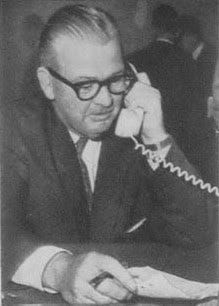
AP Foreign News Analyst Bill Ryan in New York talked with London News Editor Bob Tuckman via Telstar. (The AP World)
An Aug. 17, 1962, AP story read in part: “Research engineers sent a newspaper front page into space and back today in one minute via Telstar. Among other things, the method used in the experiment could be applied in publishing a worldwide daily newspaper, with the same edition being printed within minutes in locations thousands of miles apart.”
Telstar 1 remained active for only seven months before it prematurely failed due to Starfish Prime, a high-altitude nuclear test conducted by the United States. Although the satellite is no longer operational, it still circles the Earth. Wikipedia’s entry continually updates the number of years and days it has been in orbit.
AP continued exploring delivery through space. In March 1963 the company transmitted a wire photo via the NASA communications satellite Relay 1 to London, Paris and Rome simultaneously “and itself got the same picture by under-ocean cable on a receiver a few feet away,” the company reported. “Newspapers all over Europe made page 1 use of the picture, which reached them via the AP European Wirephoto network.”
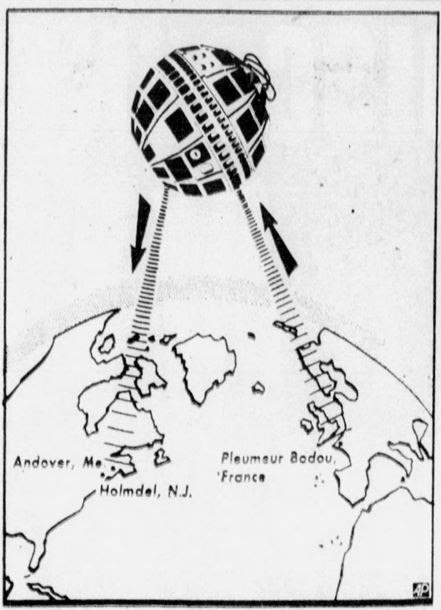
Associated Press Wirephoto graphic showing how signals were relayed through Telstar.
The AP annual report for 1962 said “An historic communications satellite, Telstar, was launched in July, marking a major step in the era of space communications. AP news stories and pictures were transmitted experimentally. Ultimately such highspeed transmission will be worldwide and on a regular basis.”
A 36-minute video of the American Telstar broadcast can be viewed here.
(With thanks to Sarit Hand, Global Manager of AP Corporate Archives, who provided considerable help researching this story.)
I can still hear "Telstar Tune" playing in my memory.
I recall the days when live programs were superimposed with “VIA SATELLITE” to remind viewers of this marvelous space-age technology.