


Give me that old time religion — or maybe not.
We’re back on the radio for the second consecutive weekend exploring the separation of church and state following the previous installment of America at 250: Due Diligence (Faith Without Force), which traced the origins of religious liberty from the persecution of dissenting Christians in colonial Virginia to today's debates over Christian nationalism, We also learned the dangers of being a Baptist or a Quaker during the American Revolution. Bill Bernardoni and I mostly asked the questions of and were enlightened by John Ragosta, who earned both a PhD and a law degree from the University of Virginia and is historian at the Robert H. Smith International Center for Jefferson Studies at Monticello and a fellow at Virginia Humanities. Our other guest, Russell Moore, the editor in chief of Christianity Today, was straightforward in responding to my skepticism that we’ve ever truly had separation of church and state in the United States.
Now we look at that tension returning, after a number of decades, to the classroom, in an episode titled ‘Whose Religion?’ which we decided to prepare after the decision of the state of Texas to require displaying the Ten Commandments in public schools.
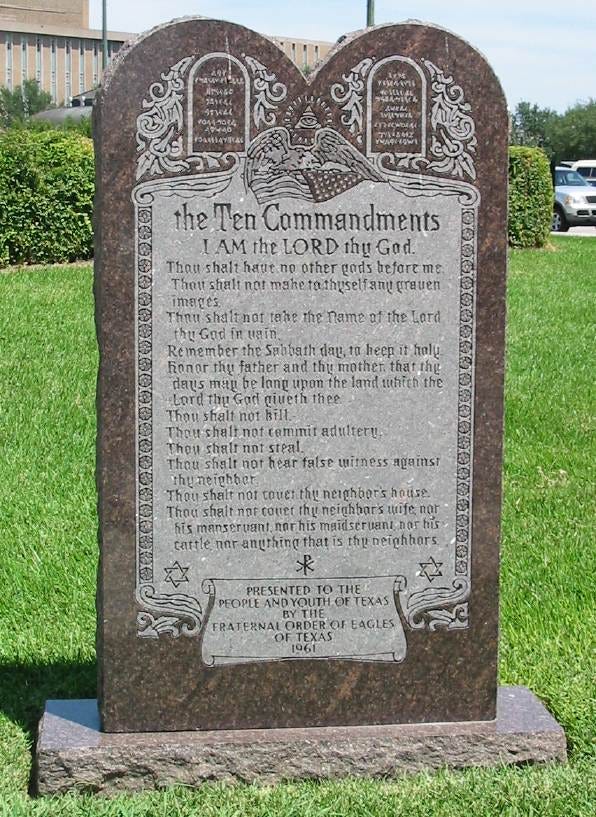
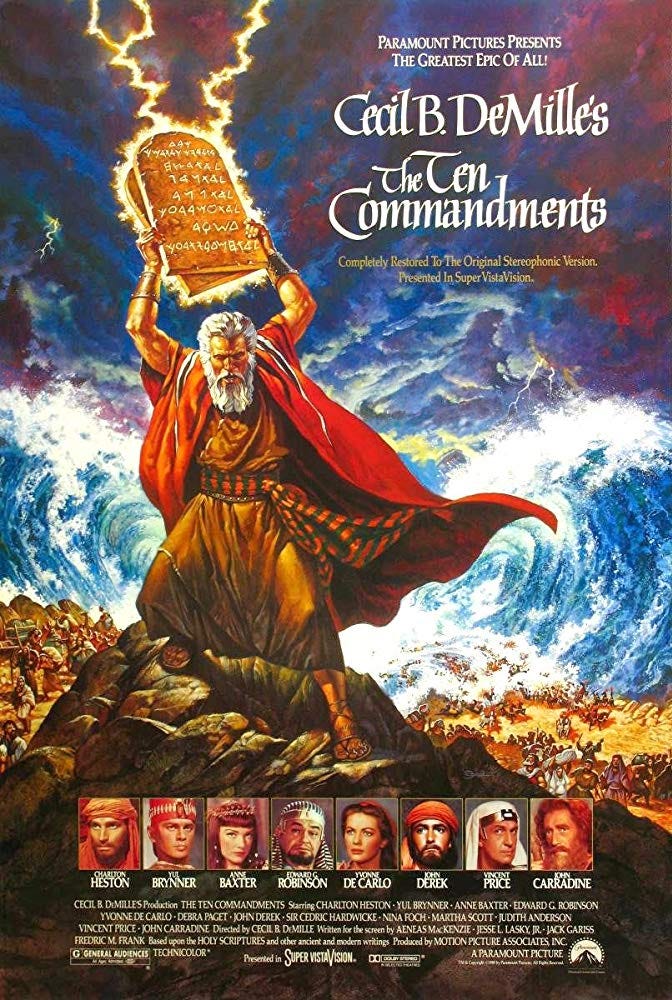
The Texas law stipulates a specific version you won’t see displayed in most churches or synagogues. Unless you are theologian it might be a revelation that there are two Biblical versions (one from Exodus, another from Deuteronomy) and three numbering traditions (Talmudic, Philonic and Augustinian) of the Ten Commandments. Texas went with the Eagles’ version. We’re not talking about the 70’s rock band or the Philadelphia football team, rather the late 19th century fraternal organization formed by six theater owners in Seattle who had gathered to discuss how to handle a musicians’ strike. Cecil B. DeMille, who produced and directed both of The Ten Commandments movies (1923 and 1956), was a member of the Fraternal Order of Eagles, which inscribed on their tablets a shortened Exodus version of the King James Bible with Americanized spelling, but retaining the 17th century sprinklings of ‘thou’ and ‘thy’ because it sounds, well, more biblical.
Similar Ten Commandments laws have emerged in Louisiana and Arkansas, while some states are also considering Bible-based curriculum and school chaplain programs. Supporters argue these policies recognize America’s history and religious heritage. Opponents say they cross a constitutional line by putting government behind a particular faith.
For this week’s episode we have Annie Laurie Gaylor, co-founder of the Freedom From Religion Foundation, discussing her organization’s legal challenges to Ten Commandments laws and why she believes freedom of religion must also protect Americans from government-imposed religion. Then religion journalist Bob Smietana joins us to delve into the political and religious forces driving these measures, the rise of Christian nationalism and why teaching about religion can be very different from government promoting it.
America at 250: Due Diligence now runs on nearly 90 radio station in the United States and is one of the few (maybe the only?) regularly scheduled weekly program that airs on conservative talk, religious and liberal (public, non-profit) stations, bridging some deep divisions, including KVOI AM 1030 Tucson (Sundays 6am); WVOG AM 600 New Orleans (Sundays 9am); WGBH FM Boston (Sundays 8pm): KSLM AM 1220/FM 104.3 Salem, Oregon (Saturdays at noon); WMQM AM 1600 Memphis (Thursdays 5pm); WITA AM 1490 Knoxville (Saturdays 1pm); WUMS FM 92.1 Oxford, Mississippi (Sundays 9am) and multiple Radio Free America™ transmissions throughout every weekend via WRMI in Florida, the largest commercial shortwave broadcaster in the Western Hemisphere.
Funding for the show comes from civic-minded contributors to the Jordan Center of Journalism Advocacy and Innovation and the support of the School of Journalism and New Media at the University of Mississippi. It is distributed via the Talk Media Network, Public Radio Exchange and the Radio Free America project. If you like what we’re doing with the radio show and podcast, we would appreciate your grassroots support by clicking here.
None of these guys in the religious right even pay attention to the ninth commandment. That’s one about bearing false witness. It’s considered to be a grave sin to speak about other people falsely. They don’t normally don’t pay attention to that.